
Everything below is built from three publicly linked addresses and the viewers everyone already uses to watch them (Etherscan, DeBank; data basis and limitations at the end). Every transfer from these wallets makes headlines within hours, and the coverage is all balance-tracking and guesswork. As far as we can tell, nobody has published actual risk numbers on the book. So here they are. If anything in the data basis is wrong, say so and it will be corrected.
TL;DR (model estimates under stated assumptions — none of them a verified fact, a prediction, or advice):
- Half the “Vitalik wallet” stories are watching the wrong address. vitalik.eth holds about $1.1M. The money — 224,183 ETH in a Safe he created, plus 6,977 ETH staked from it — sits at an address most trackers don’t name. There is also a widely circulated lookalike address with the same 25-character prefix and a $0 balance: address-poisoning bait. Section 1 sorts out which addresses this analysis covers and why.
- The book is one asset. 99.98% ETH across wallet and stake, $443.9M at July-15 closes. That is not a finding (obviously) — what it costs and returns under stress is the rest of this post.
- The simulated 1-in-20 bad year lands between −65% and −81%, depending on model choice, and a 20%+ drawdown occurs at some point of the year in essentially every simulated path under both models. The model that resamples the last twelve months puts the median year at −46%, because for ETH the last twelve months contained the first three-red-quarter run in its history.
- His announced open-source funding commitment is denominated in the thing being stressed. The 16,384 ETH he committed in January buys $31.5M of security audits and developer time at today’s price, $16.9M at the pessimist model’s median year-end, and $5.9M at its 1-in-20 year. The commitment deploys over years, which is exactly why the year-end distribution matters more than today’s mark.
- Size, not market depth, is the exit constraint. ETH is the deepest market this series has touched, and the position still equals 0.87 days of our entire measured tape. A disciplined full exit runs ~21 days under normal assumptions (including the staking exit) and ~70 days under crisis assumptions, with a modeled slippage bill in the tens of millions. Two things cut the other way, and they get their own section: nothing in this book’s obligations forces an exit on any clock, and his actual disposal pattern is donations and announced multi-year programs, not market exits.
- The honest non-results: crisis-correlation stress moves 1-day VaR by $450 — four hundred and fifty dollars — on a $443.9M book, because a single-asset profile leaves nothing to decorrelate. And the FTX-collapse replay is the mildest of the three historical replays we ran (−30%, against −42% for May 2021 and −54% for the recent bear’s core leg): exchange-failure weeks hit ETH less hard than macro regimes do.
Snapshot: positions from DeBank captures of all three addresses, 2026-07-16 (~18:00 UTC+2); engine prices are 2026-07-15 daily closes (ETH $1,919.94). The intraday capture priced ETH at $1,881 — the ~2% gap between the two marks is price basis, not position changes. Covered: $434.96M of positions re-priced to $443.89M at run prices — 99.7% of the three-address total. Exclusions and their bias at the end.
1 · Which wallet is “Vitalik’s wallet”?
Three addresses, linked on-chain, make up the canonical public book:
| Address | What it is | Holds |
|---|---|---|
0xd8dA6BF26964aF9D7eEd9e03E53415D37aA96045 | vitalik.eth, the hot wallet everyone quotes | 6.7 ETH + a few hundred gifted tokens, ~$1.1M total |
0x220866b1A2219f40e72f5c628B65D54268cA3A9D | ”Vb 3” — a Safe created by vitalik.eth | 224,182.79 ETH wallet + 6,977.49 ETH staked ≈ $434.9M |
0xAb5801a7D398351b8bE11C439e05C5B3259aeC9B | ”Vb” — his self-disclosed 2018 wallet | 16.7 ETH + meme dust + old LP positions, ~$0.3M |
Three things the daily wallet-watcher coverage gets wrong, stated here because they decide what this analysis does and doesn’t cover:
- A poisoned lookalike circulates. An address sharing the first 25 characters with vitalik.eth (
0xd8dA6BF26964aF9D7eEd9e03E…+ a different tail) shows a $0 balance and no history of being his. It has appeared in at least one research library we checked as “the canonical address.” If your source quotes a vitalik address, check the tail. - The ENS name is not where the money is. Balance checks of vitalik.eth understate the book by a factor of about 400. He has said publicly that over 90% of his personal crypto sits in a Safe multisig; the on-chain record matches.
- “Linked” wallets are excluded here. A wallet that moved 7,000 ETH on June 27 was reported as Vitalik’s by one analytics shop; he hasn’t confirmed it and neither can we, so it is out. So are the Ethereum Foundation’s addresses — the EF treasury is a separate entity with its own Safe, and conflating the two is the single most common error in this genre. And the spoof ENS name registered to look like his is out, obviously.
Everything below analyzes the three-address book and nothing else.
2 · The book
$443.89M at run prices: 231,160.29 ETH (of which 6,977.49 staked) plus ~$77K of KNC — 99.98% ETH. A long tail of gifted tokens (three tokens literally named after him, meme dust across 400+ contracts) is excluded below a $100K/pricing-identity cutoff; it totals roughly $1.3M, 0.3% of the book, and its story is told by what he does with it: historically, he donates it.
One line on composition, because it is banned as a finding here: yes, Ethereum’s co-founder holds ETH (obviously). The observations worth having are about scale and structure: the book is self-custodied (no exchange, no lending protocol, no manager — the protocol-dependency scenarios that dominated our DAO teardowns have nothing to attach to here), and it is large enough that its risk numbers are macro numbers.
3 · The simulated year, and what it does to the funding commitment
Two simulation models, deliberately different, 25,000 paths each over one year, same seed. The model-based run (zero-drift GBM on measured volatility — 63% annualized for this book) answers “what does this volatility structure do with no view on direction.” The empirical bootstrap resamples the trailing 365 days, which for ETH included the first three consecutive red quarters in its history — so it carries that year’s downtrend forward by construction.
| 1-year outcome, $443.9M start | Model-based (GBM) | Empirical bootstrap |
|---|---|---|
| 1-in-20 bad year (5th percentile) | −64.7% ($156.5M) | −81.2% ($83.3M) |
| Median year | −0.1% | −46.3% ($238.4M) |
| Expected shortfall (95%) | −72.2% | −85.5% |
| Median worst intra-year drawdown | 49.9% | 63.8% |
| Paths with a >20% drawdown | 99.9% | 100.0% |
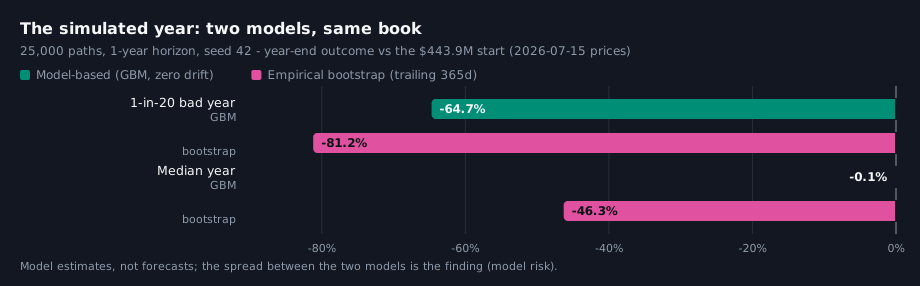
Neither column is a forecast; the sixteen-point spread between the 1-in-20 estimates is model risk, and it is the honest answer to any single-number question about a book like this. The bootstrap’s −46% median is worth a second look: it is not a tail estimate, it is what “next year statistically resembles the last one” means for an all-ETH book right now.
What that does to the announced program. In January he committed 16,384 ETH to open-source security and privacy funding, deploying gradually over several years — a commitment denominated in the asset above. Repriced at the simulated year-end percentiles:
| Today | GBM 1-in-20 | GBM median | Bootstrap 1-in-20 | Bootstrap median | |
|---|---|---|---|---|---|
| 16,384 ETH buys | $31.5M | $11.1M | $31.4M | $5.9M | $16.9M |
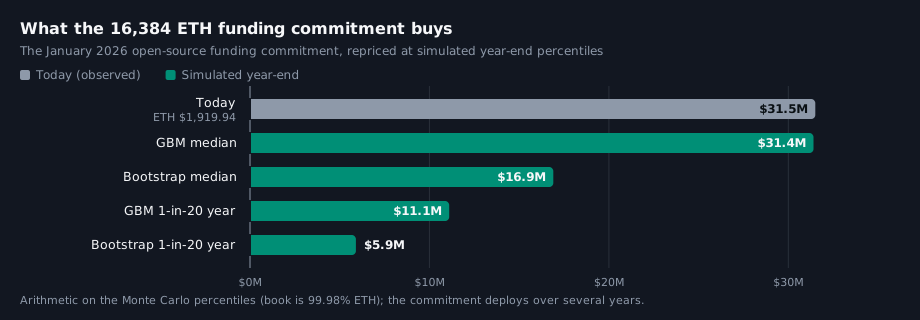
The commitment can always deliver the ETH; what the ETH delivers in auditor-hours is the open question, and the multi-year deployment schedule means the whole distribution applies, not just today’s column. (The same arithmetic applies to the EF’s own budget, but that is a different entity’s book and not analyzed here.)
4 · Shocks with dates on them
We prefer observed shock sizes to invented ones. Two from this year, applied to the current book:
| Shock | Basis | Loss |
|---|---|---|
| One more Q2-2026-sized quarter (ETH −24.8%) | CoinGlass quarterly, Apr–Jun 2026 | −$110.1M |
| A February-2026 repeat (ETH −37% in the month) | the month he sold $35M for the funding program | −$164.2M |
And three full historical replays, each applying the event’s actual daily price paths to the current book:
| Replay | Window | Result |
|---|---|---|
| The recent bear’s core leg | Oct 5 2025 → Feb 6 2026 | −54.3% (−$241.0M) |
| May 2021 crash week | May 11–19 2021 | −41.6% (−$184.5M) |
| FTX collapse weeks | Nov 1–21 2022 | −29.9% (−$132.5M) |
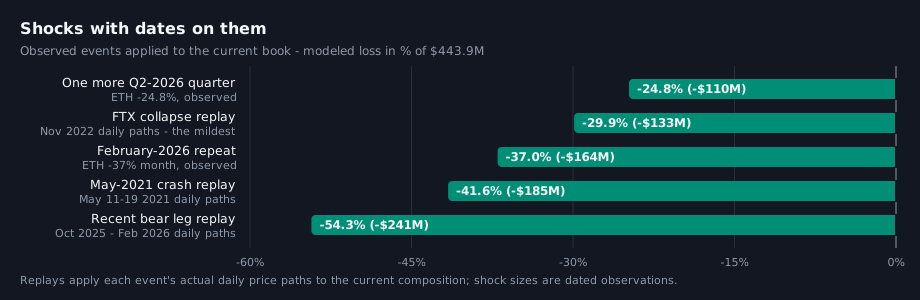
The ordering is itself informative: the exchange-collapse event — the scenario type that dominates crypto risk conversations — is the mildest of the three for this book. Self-custodied ETH has no counterparty to lose; what hurts it is the macro regime, and the deepest replay on record for it is the one that just happened. A repeat from today’s level would put the book near $203M against a $4,950-ETH-era peak mark of roughly $1.1B. That arithmetic, not any protocol event, is this book’s risk profile.
5 · The exit question nobody has priced
Every wallet-watcher story implicitly asks “is he selling?” A more useful question: could he, and what would it cost? ETH is the deepest market in this series by an order of magnitude — our venue-limited tape shows $509M of ETH trading per day — and the position is still 0.87 days of that entire tape.
Modeled as disciplined liquidation (a fixed share of daily volume, order books only):
| Normal regime (10% of volume) | Crisis regime (5%, thinned tape) | |
|---|---|---|
| Full exit of the ETH | ~21 days (11.6 for the unstaked sleeve; the staked 6,977 ETH adds the exit delay) | ~70 days |
| Modeled slippage on a full liquidation | $48.2M (10.9%) | $61.8M (13.9%) |
| Completes inside a crisis week | nothing | nothing |
Read the day-counts with their assumptions. First, the tape: our volume data is venue-limited; the all-venue ETH tape is several times deeper, and every day-count and slippage dollar shrinks proportionally with the tape you assume. What survives any tape assumption is the ratio: a position that is most of a day of global volume exits in weeks at disciplined participation, not in an afternoon. Second, and more important: nothing forces this book to exit on any clock. There is no redemption mechanism, no runway to fund, no mandate. His observed disposal pattern is the opposite of a market exit — announced sales with stated purposes, donations (often of exactly the gifted long-tail tokens this analysis excludes), and multi-year deployment schedules. The table prices an option he has shown no sign of wanting, and OTC desks exist at this scale anyway. That is the fairness note the day-counts need.
The staked sleeve deserves its own sentence: 6,977 ETH sits behind the beacon-chain exit process, which adds days-to-weeks depending on queue state. Our model applies its standard staking delay (visible in the 21-day normal-regime figure); the queue is dynamic and the number is indicative.
6 · What the scenarios agree on
- Single-event stresses cluster in the −$110M to −$184M band (a Q2-sized quarter, a February repeat, a May-2021 week). The full bear-leg replay, −$241M, sits above them; the simulated 1-in-20 year, −$287M to −$361M, above that.
- The tail is composition and nothing else. Crisis-correlation stress moves 1-day VaR by +$450 (on $24.2M) — with one asset at 99.98%, there is no diversification to destroy. The protocol-dependency risk that produced our DAO teardowns’ biggest single numbers is absent: no lending market, no manager, no exchange balance. What remains is ETH’s own distribution, at 63% measured volatility, applied to $444M.
- Liquidity is a size story, not a depth story, and it is optional — no obligation forces it.
- The one number that connects the book to something he has publicly committed to do: the funding program’s purchasing power, $31.5M today, $5.9–16.9M across the pessimist model’s year.
None of this says the position is wrong. A founder holding his protocol’s asset through its worst drawdown sequence on record, self-custodied, with no leverage and no obligations, is the cleanest large book this series has analyzed — structurally the simplest, and simplicity is why every number above is big and legible instead of hidden in protocol plumbing. If there are two quantities worth watching on a standing basis, they are the ETH-denominated commitments against the simulated year-end distribution (section 3’s table, re-runnable monthly), and the Vb 3 balance itself — which anyone can watch, and now with the right address.
Method & limitations
- Every headline figure is a model output under stated parameters (participation rates, shock sizes, covariance windows, seeds). Different defensible choices move results materially; treat everything as orders of magnitude.
- Data basis: DeBank captures of the three addresses (2026-07-16), cross-checked against Etherscan; engine prices are 2026-07-15 daily closes. The book: 231,160.29 ETH (224,182.79 wallet + 6,977.49 staked) + 700,008.5 KNC. DeBank lists the KNC as the legacy token; we price it on the current KNC series (1:1 migration) — labeled proxy, 0.02% of the book.
- Coverage 99.7% of the three-address total. Excluded (~$1.3M, 0.3%): gifted tokens without a reliable price-series identity (including one meme token whose only listed market prices 6,000× away from its DeBank mark — the kind of data trap gift-token tails are made of), LP dust, hot-wallet balances under $100K, and $102 of Aave v2. The exclusions are mostly illiquid gifts; their absence slightly understates the tail, immaterially at 0.3%.
- Simulations: 25,000 paths, one-year horizon, seed 42, reproducible; zero-drift GBM and an empirical bootstrap of the trailing 365 days. The bootstrap inherits that year’s direction — that is its purpose and its bias, stated where used.
- Liquidity model: fixed participation of daily volume with venue-depth slippage, order books only, on a venue-limited tape (ETH $509M/day). It ignores OTC entirely. The staking exit delay is the model’s standard parameter, not a live queue read.
- Replay windows as dated in section 4; both book assets have full price history for all three events — no proxies.
- Addresses per section 1; “linked” wallets with unconfirmed attribution are excluded, as is the Ethereum Foundation (separate entity). Snapshot-based: this wallet set moves episodically, and the numbers carry their dates.
- Nothing here is investment advice, a prediction, or a comment on anyone’s personal choices.